
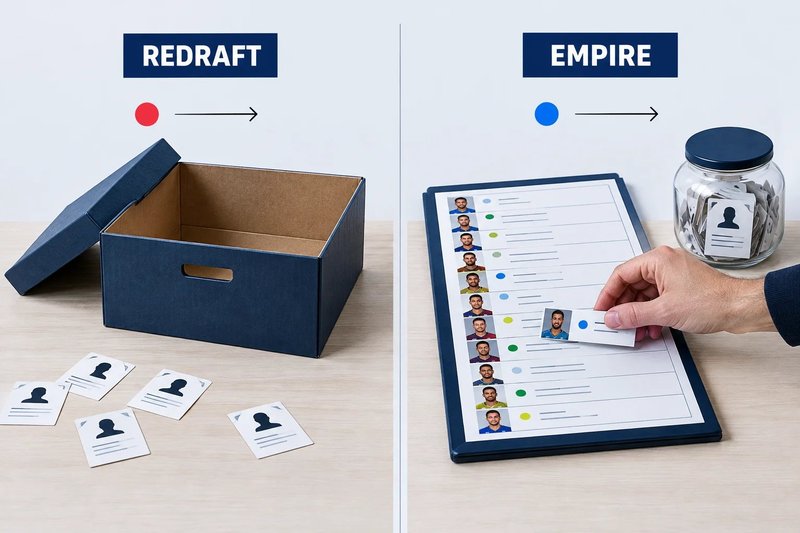
Your redraft league ends in January. Dynasty and empire don't
Your title game wraps up, the trophy gets passed around the group chat, and the roster you built in August is gone. Next summer you start over.
Meanwhile you keep hearing about dynasty and empire. Someone on your podcast feed won't stop talking about rookie picks. Someone else mentions a pot that grows every year.
Take a running example: a redraft veteran in a 12-team league, a size that is common for fantasy leagues. Every year this player drafts fresh and plays for that one season. Now they're weighing a move to a league where the roster sticks around.

Dynasty is the first step. Rosters carry across seasons, so the question shifts from "can I win this year?" to whether the team can contend in future seasons. Empire is a dynasty variant that adds takeover mechanics. In the common versions, a growing prize pot and a run of consecutive championships decide when the league resets or someone takes over. Payout splits and thresholds vary from league to league, and you can see one organized version at Empire Fantasy Football.
The sections below define empire, show how it builds on dynasty, and put all three formats side by side using our veteran's decisions.
Empire is dynasty with a pot and a reset
Empire is a dynasty league where managers keep their rosters year to year and a share of the dues builds into a progressive "empire pot." The pot goes to a manager who wins back-to-back championships. In FFPC's standard empire rules, the league then disbands. Empire Fantasy Football's version works the same way: the Empire Title wins the pot, the league dissolves, and a new empire is redrafted the next season. It describes the format as a hybrid sitting between dynasty and redraft.
Empire has no single universal rulebook. The title threshold, the prize split, and what happens after someone wins all depend on the league's constitution, as Fantasy Life's overview points out. Owners also don't automatically seize another manager's roster. Takeovers happen when a team is open.
The usual way is an orphan team. When a manager leaves, a replacement pays the league dues and inherits the existing roster, including its strengths and any draft picks it already traded away. Everyone else keeps the team they have.
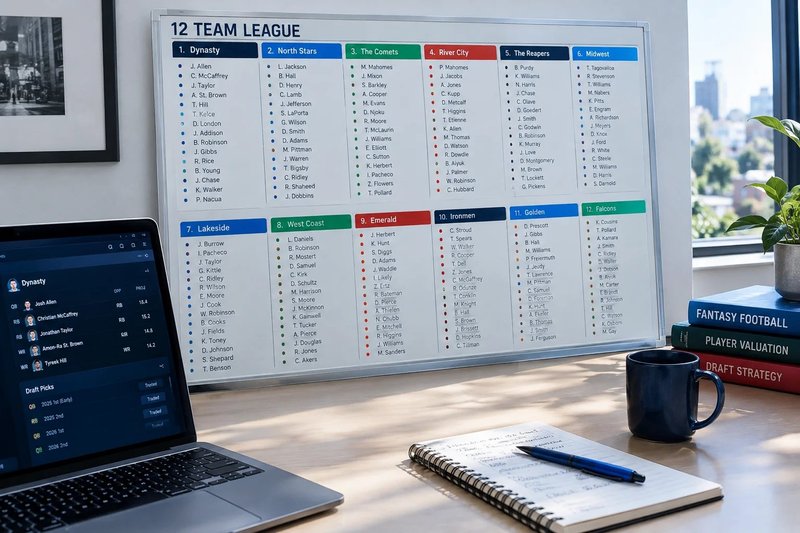
Back to our redraft veteran. In an empire league they would draft or inherit a roster, then keep it into next season. The August question changes from "who are my best 15 players this year?" to "who still holds value in two years?" They might also sit with the pot growing and a back-to-back title as the target, which pushes them to build a team that can win twice in a row rather than once.
If a spot opens in a league they like, they could pay the dues and step into someone else's roster, warts and all. Looking over that roster's picks and ages before saying yes becomes part of the game.
What empire keeps from dynasty and what it adds
Dynasty is the base. Managers hold all or most of their roster across seasons, the league pairs a startup draft with annual rookie drafts, and future picks can be traded. Players are valued on age, role, and future opportunity, not just this year's production. Empire keeps all of that, and our redraft veteran would use the same skills in both.
The added layer is that the league can end. A title threshold, often back-to-back championships, triggers a reset or takeover, so a roster is no longer something you plan around indefinitely. That one condition changes incentives in three places.
Tanking gets less appealing. FFPC's empire rules prohibit roster dumping, failing to set lineups, and neglecting waivers, and commissioners can sanction offenders or reverse trades. How well that works depends on enforcement.
Rebuilding survives but loses its open horizon. In standard dynasty, swapping a veteran for a future first is a common rebuilding move because the pick can appreciate. In empire, a reset can make that pick worth nothing, so owners need a mix of long- and short-term plays. One DynastyFF thread puts it as "rebuild forever" being less attractive.
Trade value shifts too. Managers may be reluctant to deal with a defending champion who is one title from triggering the reset. Some leagues restrict the champion's trades, and others let a champ give up their claim to the prize to trade freely.

In empire, a future pick carries a ticking clock, because a reset can erase its value before it pays off.
Is the extra layer worth it? For a veteran who likes dynasty's planning but wants an ending, yes. The reset gives a long-term league stakes and a finish line. The cost is rules complexity and more commissioner work, and if your league-mates won't read a constitution, plain dynasty is the safer choice.
Redraft, dynasty and empire compared row by row
The table covers the seven differences that change how you play. Takeover mechanics come in the next section.
| Roster ownership | Resets every year | Most or all carries over | Carries over until a reset or takeover |
| Commitment | One season | Open-ended | Open-ended, with a rules-based endpoint |
| Takeover rules | None | Usually none | Set by the league constitution |
| Strategy | Current-season points | Points plus future asset value | Dynasty balance, with the reset in mind |
| Draft | One annual draft, around 15 rounds | Startup draft, then rookie drafts | 20-round startup in FFPC, then rookie/free-agent drafts |
| Time | Mostly in-season | Year-round, deeper rosters | Year-round, plus constitution and pot rules |
| Trade culture | Short-term swaps | Picks and prospects change hands | Same, but a defending champ can be hard to deal with |
Dynasty rosters run deeper. Some leagues use 20 to 25 spots and others top 30, often with taxi and injured-reserve slots, so your commissioner's settings decide how much development room you get.
Now apply it to one decision. Our redraft veteran holds a 29-year-old running back coming off a strong year. Running backs start declining at 29, and ESPN's study found they lose 25.2 percent of their PPR points per game from 28 to 29.
In redraft, he's a fine starter. Age is only a modest discount, and next year doesn't exist. You keep him and play him.
In dynasty, he's a depreciating asset. A contender may hold him for immediate points, but a rebuilding owner sells now, because a younger player carries more long-term value.
In empire, the answer depends on where you stand relative to the title threshold. One championship from the endpoint, his next two seasons matter more than his 2029 trade value. Far from contention, you sell as in dynasty, but the pick you get back may never pay off if the league resets first.
The same player gets three different answers, so the veteran should pick a format before picking a team.
How empire takeovers work and what to define first
Empire leagues have no universal takeover procedure. The constitution sets what happens when an owner leaves and how a replacement is chosen, so the examples below mix reported FFPC rules with suggestions any commissioner could adapt.
When a team opens up. In FFPC, an owner can sell or orphan a team beginning December 23. Other leagues might trigger a vacancy on a different date, or when an owner misses a payment deadline.
What the newcomer pays. FFPC requires new owners to pay a deposit, forfeited if an owner abandons a team. A home league could require the winning bidder to cover dues plus any acquisition price the constitution names.
Who gets the pot. In FFPC, 50% of the regular prize pool goes into the Empire Prize Pool. The pot follows the franchise, so a departing manager gets no share unless they are the qualifying back-to-back champion. Home leagues often split differently, such as 70% to the yearly pot and 30% to the Empire Pot on $100 dues. A funded pot also makes orphan teams easier to fill than in plain dynasty.
Breaking ties. When two bidders offer the same amount, FFPC Standard Empire uses blind-bid tie-breakers in this order:
- Least total points
- Worse won/lost record
- Worse previous-week score
- Head-to-head result
- Virtual coin toss
Best Ball Empire drops the record and head-to-head steps.

Collusion and dumping. A departing owner can strip the roster for picks, or trade stars to a friend who will bid on the team later. Suggested safeguards include freezing trades and waivers once an exit is announced, disclosing side payments, reviewing pre-departure trades, and requiring the replacement to accept future obligations. A fixed bidding window run by the commissioner keeps the process from becoming a private deal.
FFPC gives commissioners discretion over Empire trades and disputes, with decisions described as final and the possibility of a league-wide vote. In a home league, that power only works if everyone agreed to it before the first vacancy.
Our redraft veteran should read these rules before joining, because the date, deposit, and tie-breakers decide whether a vacant team is a bargain or a trap.
Setting up your first empire league in six steps
Our redraft veteran has a group of 11 friends and a free weekend. This is the order to work in.
- Pick a platform and accept its tradeoff. Sleeper handles dynasty infrastructure well, including taxi squads and trades that include future picks and FAAB. It has no dedicated empire mode, so takeovers and pot accounting live in your own documents. FFPC builds empire rules and prize pools into the format and offers Superflex empire leagues, but it is a paid, fixed-rules environment. Yahoo is built around keeper leagues, so treat it as a poor fit for full empire tracking.
- Schedule the startup draft. Sleeper allows trading during a startup draft, but later rookie pick trades wait until it finishes. Decide up front whether you will allow startup trades at all.
- Set roster and lineup rules. Choose Superflex or one-QB, then set starters, bench size, and taxi slots. Our veteran picks Superflex with a modest taxi squad, since quarterbacks hold value longer in that setup. Whatever you choose, lock it before the draft.
- Write the constitution. Spell out the takeover trigger, pot payout, ownership changes, and what happens if the league ends without a takeover. FFPC's version defines a takeover as back-to-back championships by one franchise, and with no takeover it ends after 10 years and splits the pot among the final season's 12 owners. Add trade review, deadlines, and the exit-freeze rules from the previous section.
- Set dues and the pot. Decide how much goes to yearly prizes and how much to the empire pot. FFPC splits 50% to regular awards and 50% to a progressive pool. Its $100 standard league lists a $400 yearly progressive pot next to $200, $100, and $50 playoff prizes. Entry fees run from $100 to $5,000 per team, and owners pay a one-time deposit equal to the league fee, then only the annual fee afterward.
- Keep records. Publish a yearly ledger of contributions, payouts, withdrawals, and balance, and log every ownership change with its date.

Keep the constitution, ledger, and ownership log in one shared place so every owner can check the record.
For higher stakes, name a treasurer other than the commissioner and move money through a traceable account. Our veteran starts at $100 dues, writes the constitution first, and sends it to the group before anyone pays.
Which format to pick, and where to start
Redraft fits you if: – Your schedule is unpredictable, or you like a fresh roster every year. Limited time or a taste for fresh starts points to redraft. – You want the season to end in January and stay ended.
Dynasty fits you if: – You enjoy year-round planning, including rookie research, the NFL Draft, and offseason trades. – You can pick a competitive timeline and build roster ages and picks around it. – Your league-mates are active, because dynasty depends on managers who keep showing up.
Empire fits you if: – You want everything dynasty offers, plus a takeover condition that gives the league an ending. – You are comfortable reading and enforcing a written constitution. – You trust your league-mates with a pot, an exit-freeze rule, and vacant-team bidding.
Empire costs paperwork and trust. If your group argues over trade vetoes in redraft, it won't survive takeover bids.
My recommendation for our veteran: skip empire for now. Join a conventional dynasty startup with transparent settings, deep rosters, and committed managers, and take a startup draft over an inherited orphan team. First-year managers often sell picks and young players too early, so keep a mix of veterans and youth. Once a year or two of dynasty feels natural, add the takeover rules.
Most redraft players should keep their redraft league and add one dynasty league beside it. It shows quickly whether year-round ownership suits you.
Find out the details in our empire rankings and rookie guides.
Sources
- What Is Fantasy Football? — Bleacher Nation
- What Is a Redraft League? — Redraft Hero
- Pros and Cons of different league types : r/fantasyfootball – Reddit — Reddit
- Anyone done an Empire League? : r/DynastyFF – Reddit — Reddit
- Standard Empire Leagues Official Rules – FFPC — FFPC
- WHAT IS EMPIRE FANTASY FOOTBALL | empirefantasyfootball.com — Empirefantasyfootball
- Empire Leagues Are The New Force In Dynasty Fantasy Football — Fantasy Life
- @WsuRaiders1: 10 team $25 dynasty league has 1.01 in rookie draft http://sleeper.com/i/Qx1Q67PJYgME | Sleeper — Sleeper
- Fantasy football draft strategy: How to crush your dynasty draft – PFF — PFF
- A Championship Strategy for Building a Fantasy Football Dynasty Startup in 2026 — Sports Illustrated
- Ultimate Beginner's Guide to Dynasty Fantasy Football Leagues – FantasyPros — FantasyPros
- Empire League Trade Question : r/DynastyFF – Reddit — Reddit
- What Is a Redraft League? Fantasy Football Rules – Football Nation — Football Nation
- How To Play Dynasty Fantasy Football Vol. 2: The Startup – Dynasty Nerds — Dynasty Nerds
- Dynasty Fantasy Football Strategy: When to Contend, When to Rebuild — FF Beacon
- Building a Dynasty: The Dynasty Difference — NBC Sports
- FFPC
- Dynasty Leagues Official Rules – FFPC — FFPC
- Fantasy Football — Sleeper
- How do taxi squads work? — Sleeper Support
- How to trade — Sleeper Support
- Standard Superflex Empire Leagues — FFPC
- Can I trade during a draft? — Sleeper Support
- Dynasty Leagues Prize Structure – FFPC — FFPC
- Dynasty vs Redraft Fantasy Football: Which Is Right for You? — War Room
- Dynasty vs. Redraft Fantasy Football — Fantasy Butler
- How to Find the Right Dynasty Startup for You — FTN Fantasy
- The Beginner’s Guide to Dynasty Fantasy Football – Dynasty Football Factory — Dynasty Football Factory
- Common Mistakes People Make in an All First Timer Dynasty League? : r/DynastyFF — Reddit


